
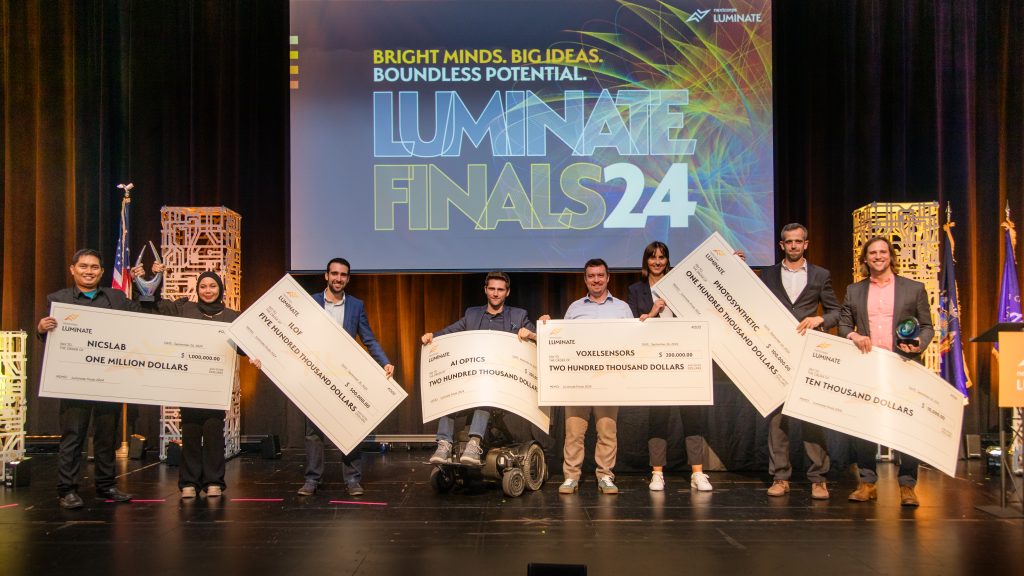
Luminate Finals 2024 was held on September 26 at Innovation Square in downtown Rochester, NY, marking the culmination of another impressive year for startups harnessing optics, photonics, or imaging to bring groundbreaking technologies to market. More than 900 registered for the event, with nearly 240 people attending in person. This year’s competition showcased innovative solutions across industries like AI, healthcare, and manufacturing, highlighting the international reach and impact of Luminate’s efforts to drive industry technologies forward.
If you missed this great event, here’s a quick recap on all the winners of Luminate 2024:
 Company of the Year: Nicslab, based in Silicon Valley, was awarded $1 million in follow-on investment. Nicslab is a fabless chip company developing integrated circuits for optical solutions in data centers, AI, instrumentation, and quantum computing. Their compact solution integrates power supply, signal processor, sensors, and controls into a single device, significantly improving performance and cost efficiency for industries like AI, healthcare, and manufacturing. The company will use the funding to manufacture and package its next generation of electronics and photonics integrated circuits at AIM Photonics facilities in New York.
- Outstanding Graduate Award: iLoF (Intelligent Lab on Fiber), based in the UK, secured $500,000 for its Al-powered photonics platform that accelerates drug discovery and development. The company has built a cloud-based library of optical biomarkers, offering non-invasive, efficient tracking, screening, and stratification for personalized medicine.
- Distinguished Graduate Awards: Two companies tied for the $200,000 prize this year. AI Optics, from New York City, was recognized for its handheld imaging device, Sentinel, which integrates AI to offer an advanced solution for disease screening, starting with retinal health. The easy-to-use device pairs AI-based detection with new imaging technology to prevent vision loss. VoxelSensors, from Belgium, received recognition for its PERCEPT sensor module, which enhances wearable tech by combining AI with sensor data to create real-time contextual analysis, improving spatial awareness and user interactions for augmented reality experiences.
- Honorable Achievement Award: Photosynthetic, a Netherlands-based startup, was awarded $100,000 for pioneering a new 3D manufacturing method. Their technology enables mass production of complex geometries with sub-micron precision, catering to industries such as life sciences, optics, and medical devices.
- Audience Choice Award: Rochester-based SaferStreet Solutions took home $10,000 after captivating the audience with its behavior-based, digital road signs. These “SmartSigns” detect unsafe driving behaviors such as speeding, mobile phone use, and seatbelt non-compliance, providing instant feedback to drivers to improve road safety.
Congrats to all 10 startups in cohort 7! While not everyone secured funding, they’re all champions in the Luminate family. We’re excited to continue supporting them and their progress as their businesses evolve and grow!
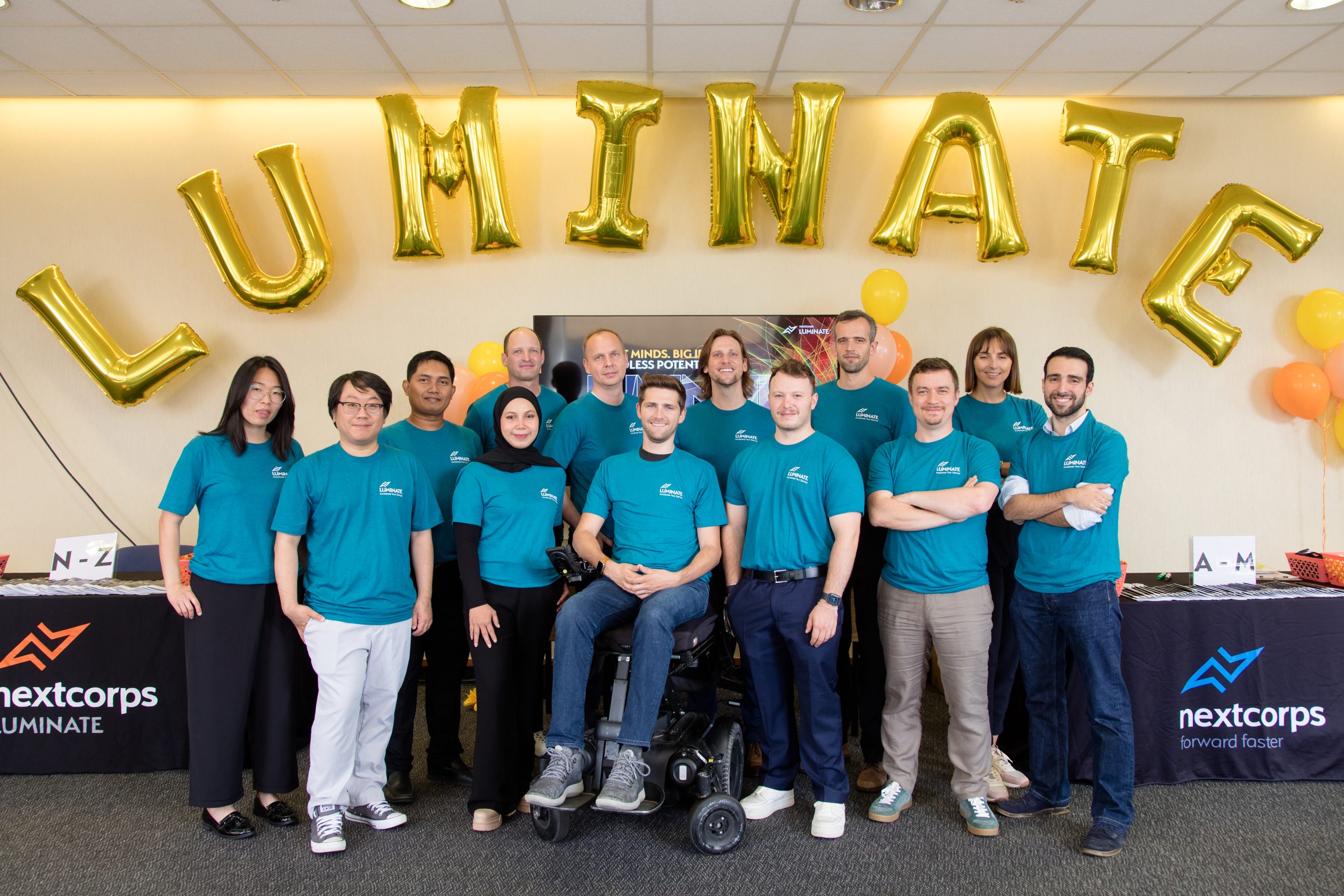
Missed Luminate Finals 2024?
No problem – you can still catch all the action!
Talking About AI, Optics, and Ethics – A Panel Discussion
The ethical use of optics and AI data was the topic of an intriguing discussion held at Luminate Finals 2024. Dan Lorca, Chief Strategy Officer for Bell Collaborative, moderated the panel conversation with Francisco Aguilar, CEO of Bounce Imaging; Charbel Rizk, PhD, CEO of Oculi; and Chris Smolinski. Jonathan Herington, PhD, Associate Professor at the University of Rochester, was unable to attend.
Lorca started by sharing that the goal was to have a “completely encompassing talk about ethics, AI, and optics in 20 minutes,” which resulted in light laughter from the crowd. After implying that he would need months to truly discuss the topic, he began by asking the panel, “What should we do about the colossal resource usage that AI requires?”
“As an engineer, power waste has always driven me crazy,” said Rizk. “It is clear that ‘AI’ is a buzz word right now, but it’s very costly on the environment.” He then cited the example of Microsoft and Amazon actually purchasing nuclear power plants. “The amount of energy used by these humongous models out there is ridiculous,” said Rizk. “There are significant impacts to us and the environment, so I would encourage you NOT to play with ChatGPT … because you’re burning a lot of energy in the process.”
According to all the panelists, overall, AI products have significant challenges and there are ethical concerns that people need to avoid. Herington shared after the event thoughts from a recent email, saying that “rushing to market without testing the product in real-world conditions, outside of your testing dataset” can be a serious problem.
“Systems make errors,” said Smolinski. “If you don’t take it seriously, you might not notice that your system has been impacted.”
Lorca introduced another issue —“One of the things that companies can certainly consider early on, is precisely what would happen if someone were to find out that you have shared their data … how would your customers feel and how would you feel?”
“If we mess with handling evidence of data; if we end up sharing a location where somebody ends up getting hurt, it’s not only problematic, it’s personal,” added Aguilar. “It’s high stakes getting data protection right … absolutely.”
Sharing data and AI models can be a concern if the data is shared for tasks other than what it was collected for. “Data is normally produced for a purpose, and we should be wary of re-purposing conveniently accessible data,” said Herington. “This is easiest to see when using training data from one sensor/platform to train a model to be deployed on a different sensor/platform. Developers should think carefully about whether and how to collect new data sources.”
It was also unanimous among the panel that the issue of cybersecurity is substantial. Rizk asked the audience to indicate how many people had received notices that their personal information had been compromised. More than half of the audience raised their hands.. Rizk admitted that he received three of these notices, alone,in the last month.”
“Without asking you to divulge information that’s proprietary, how do you treat sensitive data?,” asked Lorca.
“We work with teams and soldiers and the data we capture is governed by legal restrictions,” explained Aguilar. “We are in a very constrained environment in some things that we do, but it’s a daily conversation that can be quite heated internally in our company about what we do and don’t do with this information that we are able to capture.”
When talking about Bounce cameras and personal information, Aguilar added, “One of the things that we do is that we don’t keep the data,” said Aguilar. “When we have these cameras, I’ve had to guarantee to somebody at 4:00 in the morning handling a sensitive situation that absolutely nothing is stored on the device.”
Finally, Lorca asked, “When it comes to user data and storing it, what are the risks?” “There are some areas in medical where there’s very clear rules of how data is handled. It makes it easier for those companies,” said Smolinski. “You follow the rules and everything is good.”
“Visual data can pose a high risk of privacy violations, and developers should think carefully about ways to ‘clean’ or ‘scrub’ that data of identifiable components,” said Herington. ”For instance, sometimes all you need/want is an abstract depiction of people’s gross motor movement: and in that case, a low-res “skeleton” for each human is just as useful as the full video.”
The Bigger Picture & Applications!
Luminate has invested $18.6 million in 75 startups, and these companies have secured $281 million in additional funding. Today, the portfolio has an estimated value of $675 million, and the companies have created 164+ jobs. The Rochester and Finger Lakes area continues to expand as a global epicenter for optics and photonics, with $1M winners like Oculi (2023) moving its headquarters to Rochester and Nicslab (2024) planning on leveraging AIM Photonics facilities in New York to scale its manufacturing. This ability to tap into the region’s vast resources is a key reason for participating in Luminate.
As Luminate Finals 2024 closes another chapter, the focus now shifts to the exciting possibilities ahead for these startups as they continue to innovate and expand their impact.
Applications for Cohort 8 are in full swing, with a deadline of January 10, 2025. If your startup is working on optics, photonics, or imaging enabled technologies, this is your chance to join the next generation of industry disruptors. Apply here by January 10, 2025. Not sure if Luminate is for you? Register for one of our upcoming info sessions, starting on Thursday, November 14, 2024, at 1:00 PM EST.
Portfolio Wins
Bounce Imaging has unveiled the revolutionary Pit Viper 360, the world’s first 360° thermal tactical throwable camera, at the National Tactical Officers Association Conference. This innovation combines six thermal imaging cores and an inertial measurement unit (IMU) to provide stabilized panoramic thermal video in a compact design, significantly enhancing situational awareness for tactical applications. Partnering with Boston Dynamics’ SPOT, Bounce Imaging highlights the power of cross-platform integration, demonstrating how these technologies work together to keep first responders and warfighters safe in complex environments. With the Pit Viper 360 set for commercial release in early 2025, Bounce Imaging continues to lead advancements in tactical safety solutions.
EmGenisys has won the Innovation Award at the 2024 Animal Health Summit in Kansas City for its groundbreaking software that utilizes machine learning and computer vision to assess embryo health through smartphone videos. This innovative solution simplifies the evaluation process for veterinarians and animal breeders, enhancing breeding success rates and improving animal health outcomes.
iLof has graduated from the Unicorn Factory Lisboa Scaling Up Program, which connects high-potential businesses with top coaches for market success. CEO Luis Valente received the graduation certificate from Mayor Carlos Moedas and Gil Azevedo.
Labby has been selected as one of the Top 10 Semi-Finalists for the 2025 American Farm Bureau Federation Ag Innovation Challenge. This national competition highlights startups developing innovative solutions for challenges facing farmers, ranchers, and rural communities. Labby is the only company from New York and will pitch virtually for a chance to advance to the final four round.
Lightspeed Photonics is making headlines with its new partnership with Kaynes SemiCon, becoming India’s first paying customer for outsourced semiconductor assembly and test (OSAT) services. Announced during Kaynes Technology’s facility inauguration, this milestone underscores India’s growing role in advanced semiconductor manufacturing. The deal will see Kaynes SemiCon provide cutting-edge packaging solutions for Lightspeed’s LightSiP technology, enhancing server scalability and performance.
Nicslab CEO Andri Mahendra, Ph.D. recently appeared on CNN Indonesia to discuss the company’s involvement in the Luminate Accelerator, supported by New York Ventures and Empire State Development. He highlighted how resources from NextCorps Luminate will enhance Indonesia’s semiconductor industry by connecting it with global vendors and cutting-edge technologies.
Oculi CEO Charbel Rizk joined “Founder Shares” to discuss how their groundbreaking visual intelligence tech goes beyond traditional imaging. Oculi’s offering processes information at the pixel level, making devices smarter and more energy-efficient.
Rubitection Inc. was one of the ten startups selected to pitch at the NY Tech Meetup’s Startup World Cup: NYC Regional Competition, held on September 9 at Civic Hall. Presenting to an audience of over 400, including potential investors, they secured 2nd place and were honored with the Audience Choice Award.
Cohort 7 in the News
SeeTrue Technologies was featured in the Rochester Business Journal on August 27, 2024, for its eye-tracking sensor technology, which can detect and follow a person’s gaze with high precision. The company is developing robust sensors that can be used across industries, including enhancing medical training, AR/VR experiences, and industrial applications. Unlike traditional systems, SeeTrue’s solution only needs to be calibrated once per user, making it a game-changer for commercial and industrial use.
On September 13, 2024, the Rochester Business Journal also covered Q-Block Computing, a quantum computing hardware startup spun out from the University of Waterloo. Q-Block is overcoming critical technological challenges in quantum computing by developing fault-tolerant quantum systems. The company’s flagship product, the Q-block module, enables scalable quantum operations, making significant strides in defense and security applications.
VoxelSensors, a Belgium-based deep tech startup, was featured on September 20, 2024 in the Rochester Business Journal. The company has developed a fast and efficient light-sensing technology that improves digital experiences by seamlessly integrating AI with optic sensors. Its proprietary Single Photon Active Event Sensing (SPAES) technology enables spatial awareness and gaze tracking in XR devices to make devices more intuitive, responsive, and empathic.