
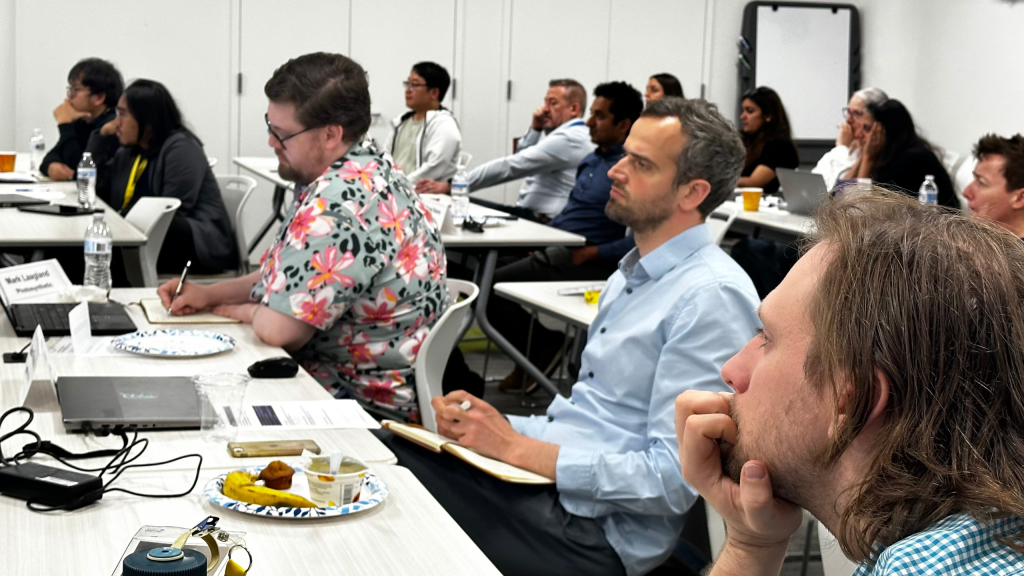
We know funding is a big reason why startups choose to apply to Luminate. With an immediate $100K investment and the potential to receive up to $1M from New York State at the end of the program, the dollar signs are enticing. What many of our teams don’t immediately understand but quickly discover is that the greater value lies in the depth of business training; the specific, tech- and needs-based mentoring; and the many opportunities to form connections with industry experts, suppliers, manufacturers, and, yes, investors. All of it adds up to a sound business — one that attracts funding well beyond the six months at Luminate.
Slightly more than half-way through their time with us, the teams of cohort 7 have taken over 40 workshops. They’re now prepping for multiple investor pitch opportunities starting next month, and we’re getting closer to Luminate’s culmination — and the awarding of the big checks — at Finals 2024 in late September.
Registration for Luminate Finals 2024 is now open! Join us online or in person in the heart of Downtown Rochester to see for yourself how the startups of Luminate’s cohort 7 are unlocking new solutions, solving pressing problems, and disrupting entire industries. This year, our event is moving to 4:00 PM EDT, allowing for in-person networking before and after!
Using Feedback as Fuel for Growth

Feedback is essential to growth and improvement. In the startup world, the ability to receive and learn from feedback is one of the biggest things investors look for in the founders they’re going to invest in. It’s imperative to success, but commonly very challenging.
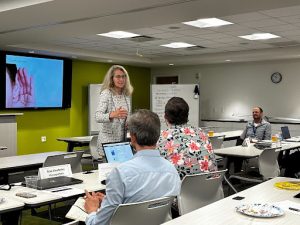
In another first for Luminate curriculum (see our recap of a new course on working with photonics clusters and associations), we invited Harvard professor and certified executive coach, Linda Cyr, PhD, MS, to lead a class on giving and receiving feedback. Dr. Cyr drew on her extensive background equipping leaders at both startups and global corporations with tools and strategies to tackle complex challenges, inspire collaboration, and lead more effectively.
During the interactive session, cohort 7 teams discussed questions like, What exactly is feedback? Why is it important to get right? What are some attributes of effective feedback? Groups reflected on pre-work given, describing situations when feedback was helpful and not so helpful.
We’re all familiar with what effective feedback looks like. Researched-based attributes include that it’s specific, timely, balanced, interactive, goal-focused, and credible. However, as Dr. Cyr put it, “We know it when we see it, but knowing doesn’t seem to be helping.”
In fact, in a survey of more than 7,600 people, 44% agreed that giving negative feedback is stressful or difficult. In a separate study of more than 7,800 people, 21% admitted that they avoid giving negative feedback altogether.
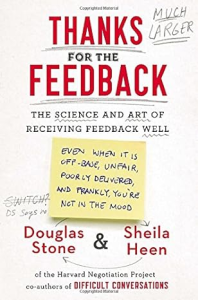 Dr. Cyr cited the work of Douglas Stone and Sheila Heen from the Harvard Negotiation Project when she said, “Rather than focusing on the giving half, perhaps it’s better to shift the focus to our ability to receive feedback, even when it’s delivered terribly. It is the receiver who decides what to let in, how to make sense of it, and whether or not to change. Stone, Patton, and Heen argue that the fastest way to change the feedback culture in any organization is for leaders to become better receivers.”
The tough part in receiving feedback arises from a tension between two core human needs: We want to learn and grow, but we also want to be accepted and respected as we are now. When feedback comes in fast and hard, Cyr explained that we often turn to “wrongspotting” — an emotional reaction where we’re triggered to point out everything wrong with the feedback.
 So how do we brace ourselves to be better receivers without letting it crush us? The simple answer is — like with so many skills — practice. Cyr suggested we start by asking for “just one thing” you could improve upon or change in routine, low-stakes scenarios. This signals you want feedback and is a simple practice that can be woven into the day-to-day.
Here are some other practical tips to keep in mind when either giving or receiving feedback:
- Listen carefully. When we feel someone is listening to us, we are more relaxed and willing to reflect in a non-defensive way.
- Ask questions. Be curious, not judgmental.
- Be explicit. Particularly when giving feedback, state aloud your good intentions. Be clear about your expectations, as well as your confidence in the person’s ability to change or step up to the challenge.
- Pause. Especially when receiving feedback, take a moment to unpack vague labels through questions like, “What is it you mean when you say…?” “Would you share examples?”
- Seek ways to see personal blindspots. Pay attention to your own facial expressions, body language, tone of voice, behavioral patterns, and impact on others.
It can be difficult to hold up an honest mirror and make the jump from, What’s wrong with this feedback? to What might be right? However, as Dr. Cyr shared, “Sometimes the people we find most frustrating can offer us the best advice.” By learning to embrace feedback and being open to change, we become better at giving feedback and cultivating a culture of continuous improvement.
Cohort 7 companies also recently attended training on:
- Building a sales and marketing system and strategy for lead gen, with Michel Nichols, Owner and President of Launch Team.
- Navigating tax and accounting strategies, with Josh Hoffman, CPA, Partner in EFPR Group’s Tax and Business Service department.
- Creating a brand built for growth, with Holly Barrett, Chief Marketing Officer at NextCorps.
- How to build an engaging website, with Kate Leonard, Digital Marketing Manager at NextCorps.
- The evolution of IP and VC investment strategies, with Dr. Darius Sankey, Luminate board member and Managing Director of Innovation Acceleration Capital.
- Mindfulness with Sabrina Vogler, Certified Professional Coach, Executive Coach, and Grief Specialist in private practice at Heart in the Moment Mindfulness Coaching, LLC.
- Patents and IP considerations for new ventures, with patent agent Lou Horvath.
- Business entity structures, with Mario Fallone, Partner at Akerman and Co-Chair of its Venture Capital and Emerging Growth Companies Practice.
- MathWorks’ key mathematical computing software products, MATLAB and Simulink, plus its accelerator and startup programs, with Taylor Hatcher, MathWorks’ Accelerator Program Lead; and James Wiken, Senior Application Engineer.
- Government registrations and certifications, with Amber Stevens, Senior Procurement Counselor at the Monroe County Finger Lakes APEX Accelerator.
- Steps to successful grant funding, with Margit Brazda Poirier, GPC, MS, Owner and Founder of Grants4Good LLC.
Optics News to Know
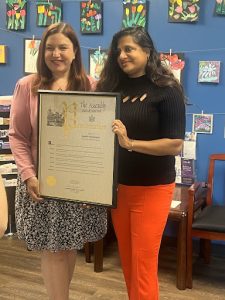 Congratulations to Luminate’s Managing Director and Chief Investment Officer, Dr. Sujatha Ramanujan, who recently accepted a 2024 Woman of Distinction Award from NYS Assemblymember Jennifer Lunsford.
Buffalo-Rochester-Syracuse tech hub awarded $40M federal investment
OptiPro Expands in Wayne County
Silicon Catalyst Ventures (SCV) looks for early stage IC investments
Portfolio Wins
SunDensity, Inc. announced the formation of its new, wholly-owned subsidiary, SunDensity Canada, with the acquisition of solar materials company (and fellow Luminate graduate) QD Solar, Inc. The asset acquisition agreement allows the organizations to explore a wider range of materials and processes for solar applications and promises to accelerate technology development.
Scout Space was tapped by the Pentagon’s Defense Advanced Research Projects Agency (DARPA) to join its Bringing Classified Innovation to Defense and Government Systems (BRIDGES) Consortium. Scout will be working under the BRIDGES research topic, “Advancing Autonomous In-Space Threat Response for Space Superiority,” through which the agency is looking for new methods and technologies that may provide warfighters with disruptive options for protecting and defending space systems across the competition continuum.
Scout recently signed an agreement to launch its “Owlet-01” telescope as the primary customer payload on the third flight of ABL Space Systems’ RS1 small-satellite launcher scheduled for later this year. This comes on the heels of Scout announcing its optical payload, dubbed “Sparrow,” launched aboard the Apex Aries bus on the SpaceX Transporter 10 mission in March 2024, successfully completing commissioning and capturing of its first in-space calibration image.
One Silicon Chip Photonics (OSCP) is racking up coverage for its inertial optical system that matches the accuracy of navigational sensors used in the aerospace industry at a fraction of the cost. OSCP recently secured $1.2M in seed funding from 7percent Ventures and 2050 Capitol, which will allow it to accelerate its growth. The company has also been named a semi-finalist for cohort 8 of GENIUS NY, the world’s largest accelerator focused on uncrewed aerial systems (UAS) and advanced air mobility (AAM) technologies.
VoxelSensors introduced PERCEPT, a groundbreaking innovation that leverages the company’s proprietary Single Photon Active Event Sensor (SPAES) technology to deliver an unparalleled combination of eye tracking and spatial awareness capabilities to wearable and mobile devices.
Circle Optics has been selected by SpaceWERX for a Phase I STTR in the amount of $110K, which will be used to support customer discovery for space domain awareness.
EmGenisys was awarded a spot in the BioTools Innovator 2024 Accelerator, the first accelerator dedicated to supporting life science tools and diagnostics startups.
SaferStreet Solutions is reminding more Washington drivers to be safe, as four SmartSigns were recently installed to rotate throughout six cities in Pierce County. The signs are funded by a grant from the Governors Highway Safety Association and General Motors.
Lidrotec was the runner-up at the third annual Lam Capital Venture Competition, which aims to invest in disruptive companies that advance the semiconductor ecosystem through next-generation industrial automation, technology, and product innovation.
Oculi landed a spot on Invest NY’s Q3 2024 list of Top Startups to Watch in Upstate New York.
New SBIR/STTR Fast-Track Pilot
Do you have NSF (National Science Foundation) lineage? You can now submit a single proposal that can provide a pathway for up to $1,555,000 in non-dilutive funding, access to the full suite of NSF SBIR/STTR Phase I and Phase II funding opportunities, and enable a rapid, seamless transition from Phase I to Phase II. Learn more and apply.