
Via Rochester Business Journal

Quantum computing is set to revolutionize our future by transforming how we process information. This could vastly enhance machine learning, optimize complex problems, and lead to breakthroughs in fields such as cryptography and drug discovery.
Although still in its early stages, the potential of quantum computing to reshape our world is immense, promising advancements that could redefine the boundaries of technology and knowledge.
Standing in the way of quantum application development—projected to become a $5B market in the coming years—are complex technological hurdles. Among them are scalability, and in quantum photonics, the ability to harness and control the intricacies of light.
A Canadian quantum hardware startup spun from the University of Waterloo, Q-Block Computing, works to solve these challenges, delivering quantum devices for advanced computation, communication, and sensing applications.
“Our mission is to develop fault-tolerant quantum systems using the fundamental building blocks of nature—atoms and photons,” said Dr. Kyung Soo Choi, Q-Block Computing Founder and CEO. “Our solutions harness that immense power for computation, helping quantum researchers and developers explore the limits of what is computable, and providing critical solutions for applications around the world, including those related to defense and security.”
Q-Block Computing helps propel quantum technology
Choi has been researching quantum science and technology for more than 20 years, serving as a professor at the University of Waterloo and its Institute for Quantum Computing, Korea Institute of Science Technology, and Caltech. During that time, he developed four critical photonic tools to aid his quantum research, including an ultra stable laser, quantum-limited photodetector, high-speed optical modulator, and ultra-high-Q optical resonator.
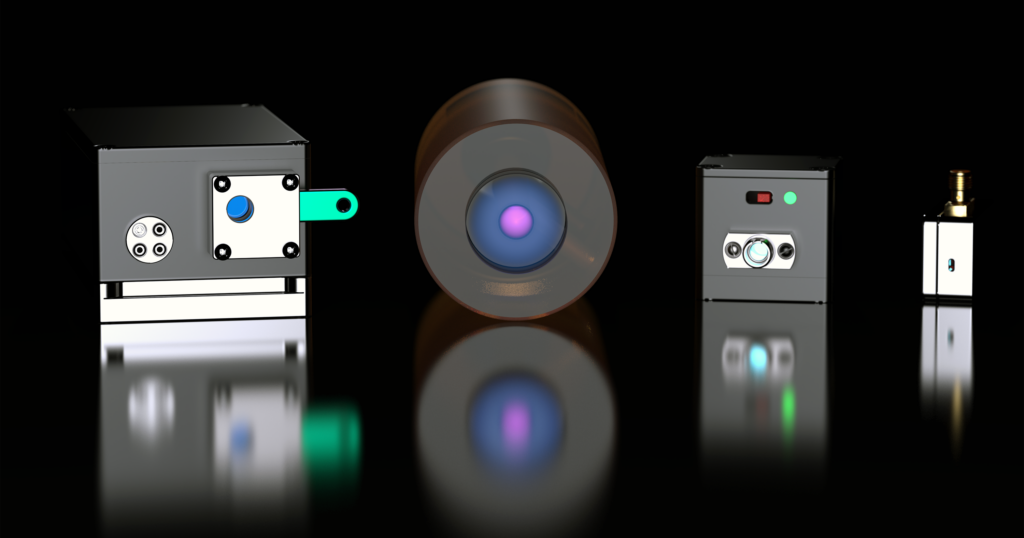
In 2020, he commercialized those tools for use by other researchers in quantum development and created Q-Block Computing to build on their potential. The photonics tools led to the creation of the company’s flagship product, the Q-block module, an integrated quantum photonic platform for scalable operations of hundreds of thousands of laser fields.
In addition to providing solutions for quantum R&D, the startup creates quantum sensing and communications solutions for the defense and security markets. The Canadian military is currently using prototypes of its Q-block modules, including AllanQ, a quantum clock solution for radar systems in long-range object detection and characterization, and LuciaQ, Q-Block Computing’s quantum memory solution for scalable quantum networking and in-network quantum computing.